Rwanda Advances Efforts to Turn Early Warnings into Timely Action

Rwanda is strengthening efforts to ensure that weather and climate information leads to timely, coordinated and inclusive action at local level, as stakeholders work to make early warning systems more effective and responsive to the needs of communities.
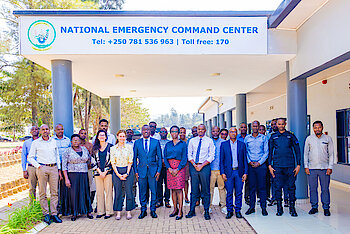
This was at the centre of a four-day Sub-National Co-Production Training on Early Warning Systems held in Musanze from 7 to 10 September 2026, bringing together about 50 participants involved in the production, communication and use of weather and climate information, disaster risk management, emergency preparedness and sector-specific decision-making.
The training brought together District Disaster Management Officers (DDMOs), Meteo Rwanda, Rwanda Water Resources Board (RWB), the Ministry in charge of Emergency Management (MINEMA), Ministry of Environment, Ministry of Local Government, Ministry of Gender and Family Promotion, National Council of Persons with Disabilities and other stakeholders.
During the training, MINEMA Permanent Secretary Ngoga Aristarque stressed that effective early warning must connect scientific forecasts with an understanding of their consequences and the actions required to protect people and livelihoods.
“Effective early warning systems must go beyond predicting hazards to anticipating their real-world consequences on people, infrastructure and livelihoods,” said PS Ngoga.

He noted that the training provided an opportunity to strengthen the capacity of District Disaster Management Officers and other government staff to effectively package and communicate weather and climate information, particularly as Rwanda prepares for potential climate-related impacts during the September–December rainy season.
The Director General of Meteo Rwanda, Aimable Gahigi, underscored the importance of using available forecasts to strengthen preparedness and resilience.
“The September–December forecast indicates strong El Niño, which is expected to have varying impacts. Let us use this forecast to strengthen resilience against climate-related impacts,” DG Gahigi said.
The training focused on strengthening Rwanda’s forecast-to-action value chain, recognising that an effective Early Warning System goes beyond the production of accurate forecasts. It requires risk knowledge, monitoring and forecasting, effective warning communication and dissemination, and the capacity of institutions and communities to take timely and appropriate action.
Through a co-production approach, participants examined how warnings are generated, communicated, received, interpreted and acted upon at district and community levels. They also identified the information needs of different users, including farmers, local authorities, emergency responders and vulnerable groups.
A key focus was the transition from traditional weather forecasting to Impact-Based Forecasting and Action-Based Forecasting; moving from communicating what the weather is expected to be, to understanding what it is likely to do and determining what action should be taken.
Participants worked together to identify priority hazards and anticipated impacts, and to develop prototype hazard-impact relationships, action tables and user-centred warning products. The aim is to make warnings more accessible, understandable, trusted and actionable for those who need to make decisions before hazards occur.
Inclusivity was also central to the discussions, with participants examining how early warning information can better reach persons with disabilities, women, children, older persons and other groups that may face additional barriers in accessing or acting on warnings.
The participants tested the forecast-to-action process through a scenario-based simulation exercise involving an El Niño-related heavy rainfall and multi-hazard event affecting selected districts. Teams were required to assess risks, determine appropriate warning and communication channels, translate technical forecasts into localised messages and identify pre-emptive actions, including evacuation and measures to protect vulnerable populations.
The simulation helped identify operational gaps, including delays in translating forecasts into local-level action, challenges in mobilising resources for anticipatory measures and gaps in last-mile verification of warnings. These lessons will inform efforts to strengthen coordination and operational readiness across the forecast-to-action value chain.
The training contributed to the development of draft Action-Based Forecasting products, operational workflows defining institutional roles and communication pathways, and a draft Rwanda ActionFirst plan outlining priority actions, institutional responsibilities and capacity development needs.
The engagement forms part of the WISER ActionFirst initiative, implemented through collaboration involving Meteo Rwanda, MINEMA, the UK Met Office and the World Meteorological Organization (WMO), among other stakeholders. The initiative supports Rwanda’s broader efforts to strengthen people-centred, impact-based and action-based early warning systems.

Rwanda Begins Handover of New Homes to Disaster-Affected Families
Rwanda has continued to restore safe and resilient housing for families affected by disasters, with thousands of homes constructed or rehabilitated as…

Rwanda Tests Flood and Drought Anticipatory Action Frameworks Through Multi-Hazard Simulation Exercise
Karongi, 28 September 2026 — Rwanda has launched a five-day Inter-Cluster Multi-Hazard Simulation Exercise (SIMEX) in Karongi District to test and…

Inter-Camps Tournament 2026: Sport Unites Refugees, Showcases Talent and Opens Pathways to Self-Reliance
The fourth edition of the Inter-Camps Tournament concluded in Mahama Refugee Camp with a vibrant celebration of sport, talent and community cohesion,…

Rwanda Mobilises Communities to Prevent and Reduce Disaster Risks Ahead of the 2026 Rainy Season
Communities across Rwanda have been mobilised to strengthen disaster preparedness and reduce the potential impacts of heavy rainfall expected during…

Rwanda Advances Climate and Disaster Risk Analytics Through GRMA Technical Workshop
The Ministry in Charge of Emergency Management (MINEMA), in partnership with the Global Risk Modelling Alliance (GRMA) and the Global Shield Solutions…

MINEMA Strengthens Rwanda’s Preparedness for CBRN Emergencies Through Tabletop Exercise
The Ministry in Charge of Emergency Management (MINEMA), in collaboration with the European Union Chemical, Biological, Radiological and Nuclear…
MINEMA and World Bank Strengthen Emergency Financing Preparedness Through Simulation Exercise
The Ministry in Charge of Emergency Management (MINEMA), in partnership with the World Bank, conducted a two-day Tabletop Simulation Exercise for…

Rwanda Welcomes 177 Asylum Seekers Evacuated from Libya
Rwanda in partnership with the United Nations Refugee Agency (UNHCR), has welcomed 177 asylum seekers evacuated from Libya, marking the 24th group…

Minister Murasira Calls for Citizen-Centred Service Delivery in Nyaruguru District
On Friday, July 31, 2026, the Minister in Charge of Emergency Management, Maj. Gen. (Rtd) Albert Murasira, who also serves as the Government…